
Forged by Fire,
Formed by Fortitude
As a child, Giselle was a true Jean Louise Finch—a nonconformist, curious and courageous tomboy with an unconventional upbringing. The youngest of four, she was the least complicated and most free-spirited, happiest in the company of her own imagination.
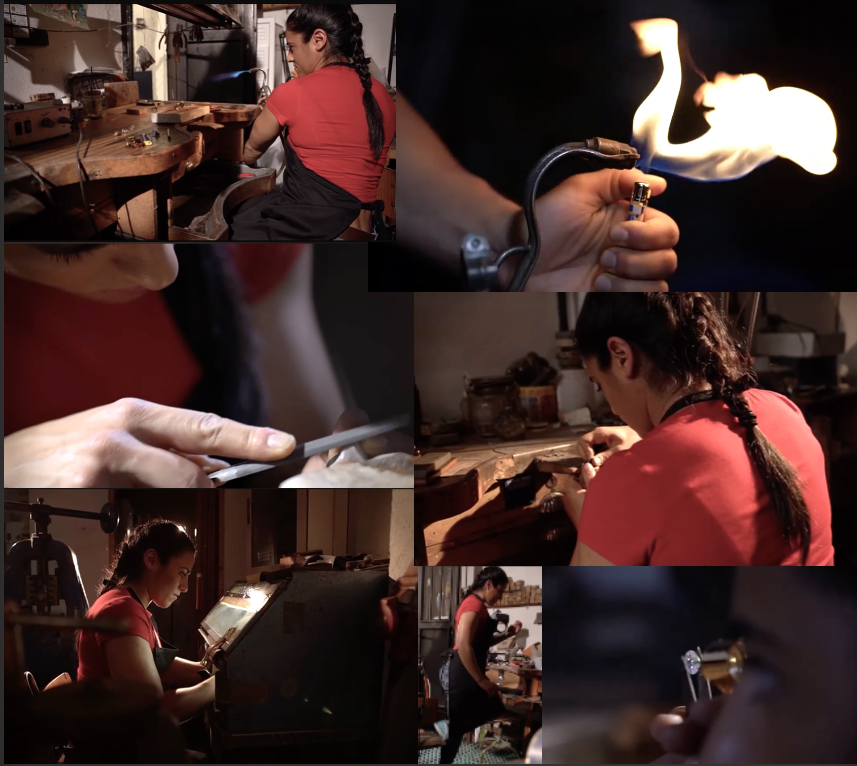
She spent much of her childhood tinkering with tools at the jeweller’s bench, learning to manipulate metal through fire and oxygen and, eventually, to fashion jewellery with precision. Working with people’s most precious possessions taught her the importance of craftsmanship, but also of service: every piece belonged to someone, and often marked a moment of significance in that person’s life. Jewellery became her first education in beauty—not beauty as extravagance, but as something made with care, imbued with meaning and capable of enduring long after the moment for which it was created.

Into the Unknown
Leaving jewellery required Giselle to do something unfamiliar: walk away from a world she understood.
What followed was less a conventional career path than a period of exploration. She entered finance and corporate life, travelled, worked across industries and countries, and deliberately placed herself in environments where she had something new to learn. Her work would eventually take her from offices to consulting assignments in South Africa, and even to the front counter of an automotive garage. Each environment offered a different way of understanding how people work, what they value, and how organizations function.

Sport remained a constant throughout. An accomplished athlete from a young age, Giselle had been named Female Athlete of the Year and ranked among the top athletes in the Greater Toronto Area while still in school. Years later, while completing her MBA in Spain, she returned to competition through rugby, playing with the Madrid Lions and competing at the MBAT Games. Weightlifting and strength sport followed.

For a time, Giselle went where the tide took her. It took her through different industries, countries, workplaces and ambitions. She accumulated experience, education and skills, often pursuing the things she believed would make her more capable—and, perhaps, more employable. But for all the movement, she rarely found a place where she truly fit. Some environments demanded too much and valued too little; others simply asked her to become someone she was not. What had begun as exploration gradually became a more difficult reckoning with the kind of life she was trying to build.
Eventually, the pattern became impossible to ignore. Giselle had spent years trying to become valuable to institutions without asking whether those institutions reflected what she valued. The question was no longer where she could fit, but what she believed work ought to be—and what kind of life was worth building around it. That question would eventually become GS Fortitude.

Building What She Could Not Find
GS Fortitude grew out of Giselle’s experience across remarkably different worlds. She had worked with her hands and inside corporations; in finance, consulting and service; across industries, countries and cultures. The environments changed, but many of the tensions did not. Too often, work seemed to ask people to separate performance from meaning, ambition from responsibility, and commercial success from its human consequences—both for the people responsible for creating value and those ultimately receiving it.
She began GS Fortitude as a consultancy, believing she could help organizations work differently. But consulting revealed its own limitation. The question was rarely simply what ought to be done, but what could be justified commercially. The ordering of values Giselle was trying to articulate could not take root while commercial performance remained the measure against which every other good ultimately had to defend itself.

GS Fortitude therefore became something more ambitious. Rather than simply prescribe a different way of doing business, Giselle decided to build one. At its foundation is a philosophy of the Good, the True and the Beautiful—not as abstractions, but as an understanding of what human beings can become within the environments we create. A business forms people. Those people, in turn, shape families, communities and institutions. The effects of how we work therefore extend far beyond the boundaries of the organization itself.
The media company became the voice of that experiment, and boxing its demonstration. Both make the philosophy public: one through ideas and storytelling, the other through the uncompromising demands of performance. The ambition is not to present GS Fortitude as the model for how others should work. It is to demonstrate that another model is possible—and, in doing so, perhaps give others the confidence to build differently too.